Four Questions with Judith Schaechter
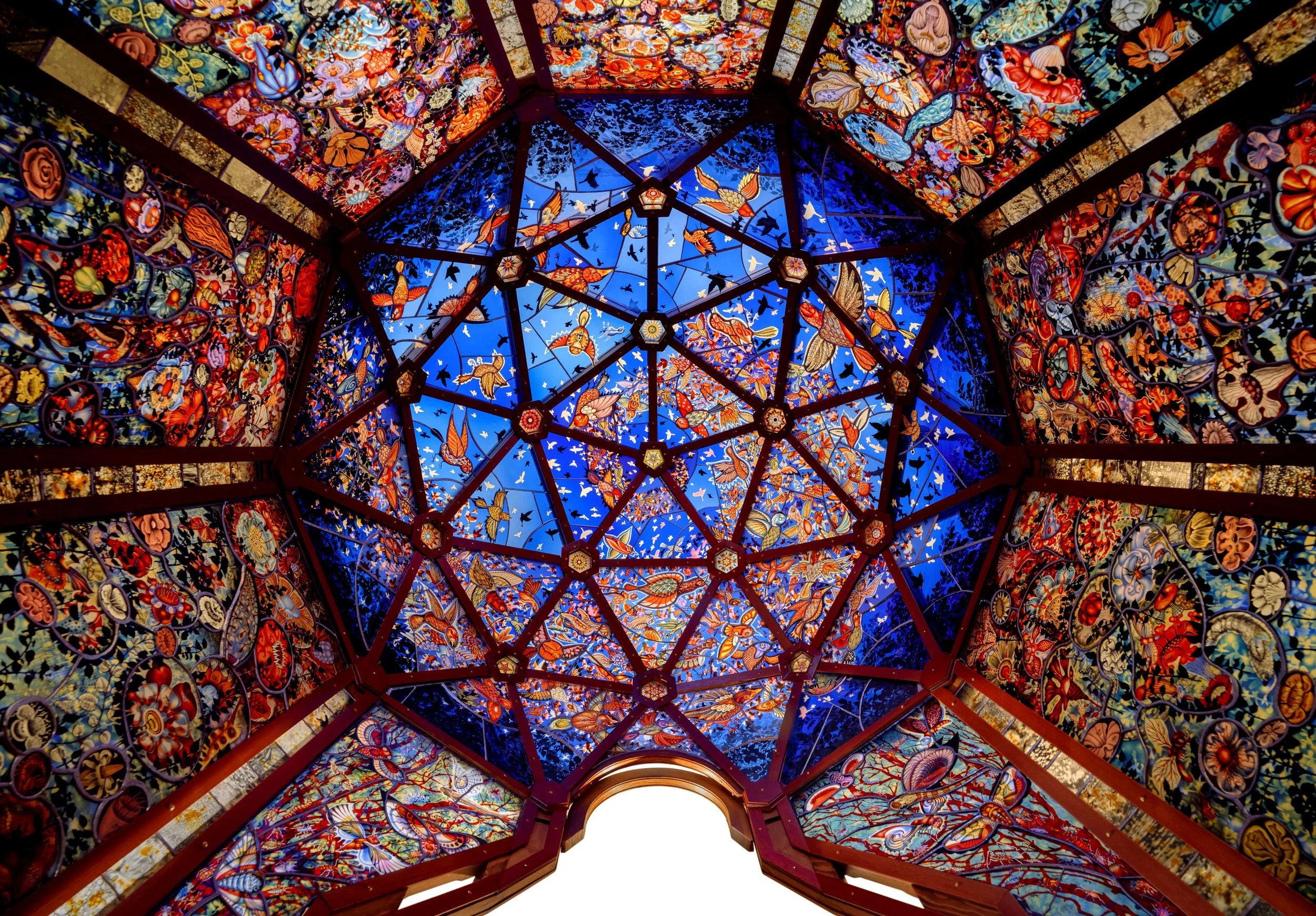
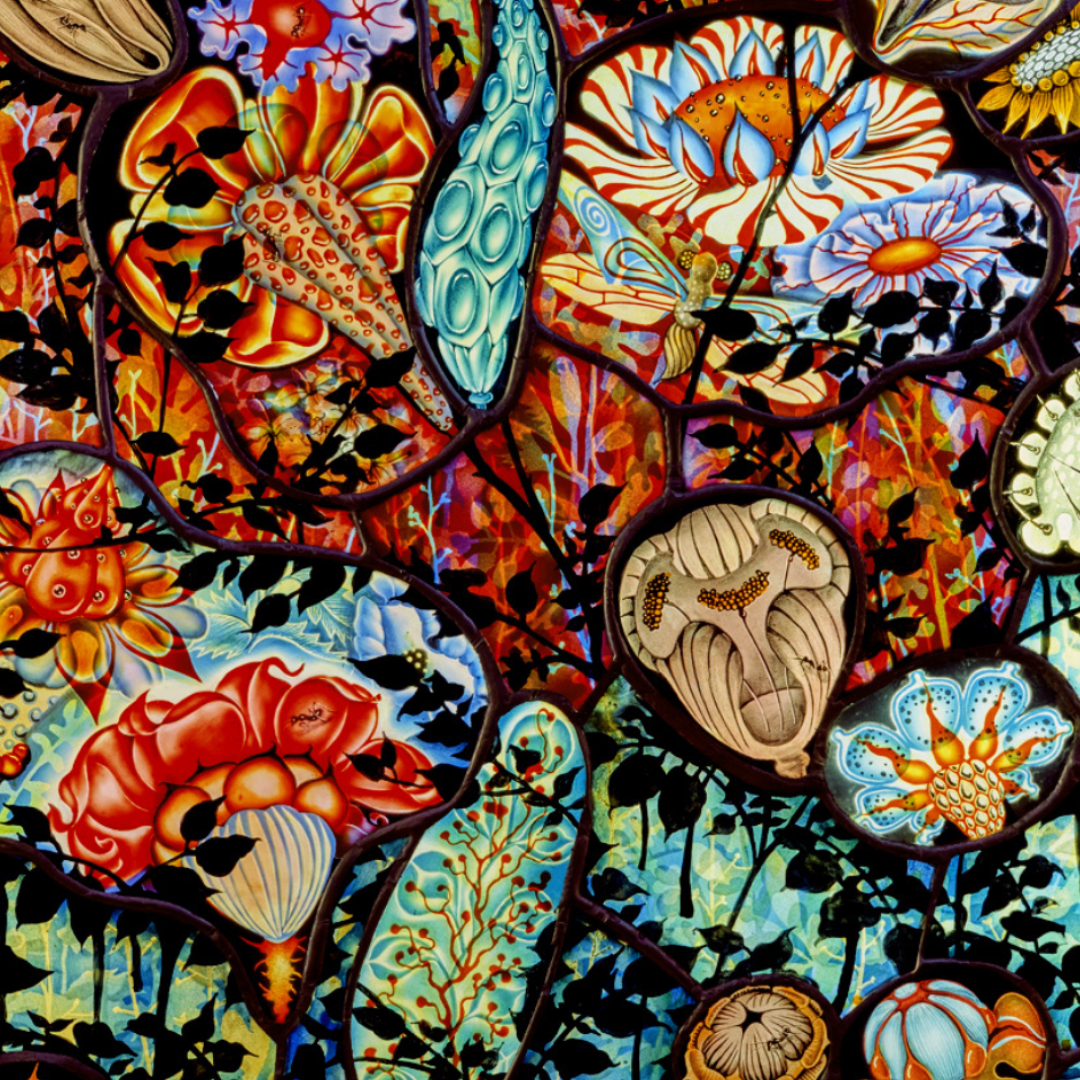
Stained glass artist Judith Schaechter’s immersive installation "Super/Natural" has been called a “shrine to human aesthetics,” a “secular sanctuary,” and simply, “a masterpiece.” Previously on view at the Michener Art Museum in Doylestown, PA and now on view at the Museum of Craft and Design in San Francisco, CA, the eight-foot-tall dome is a luminous, three-tiered cosmos rendered in glass. The piece was created during a nearly two year artist residency at the Penn Center for Neuroaesthetics, incorporating insights from biophilic design and the rich history of women’s contributions to botanical art.
Schaechter is scheduled to discuss her monumental exhibit during a Weeknights at the Wagner talk In Conversation with Judith Schaechter: Science, Art and the Super/Natural at the Wagner on Thursday, December 11th at 6pm. The artist graciously sat down with us ahead of time to answer a few eager questions about her piece and the residency that enabled it. This interview has been edited for clarity.
Interviewer: Can you tell me what it was like to be the resident artist at the Penn Center for Neuroaesthetics?
Schaechter: When I found out the center had an artist in residence, I got very excited and I very much wanted to do it. Before I was even there, I realized it was basically the one and only thing on my bucket list. So I was really enthusiastic and it met my expectations in many ways. It was stimulating intellectually, artistically, and creatively.
Interviewer: The Center incorporates researchers and scientists that study “the neural and biological basis of aesthetic or arts experiences.” What exactly do you think that means–to have a neural or a biological experience to art?
Schaechter: Well, there’s a question! My father was a scientist, he was a microbiologist, and so I grew up with a science-y atmosphere. I was taught to believe that the basis of everything is biology. Sometimes I wish I did not believe that, but that is what I learned first and learned best in life. So I always believed that aesthetic responses are rooted in our biology. Before you can even say the word “CULTURE” you are, somehow, being indoctrinated into an aesthetic experience because it is the very basis of how we make our way through life, how we look at anything, and I was interested in exploring it more obviously and directly with the Center for Neuroaesthetics.
Specifically I was always interested in things like beauty. There are things that are beautiful in nature that are very bad for you, such as certain berries and mushrooms and–they’re lovely! So It’s not as simple as if you think it’s pretty you should stick it in your mouth. Or you should consume it in any way. And I think that has repercussions for culture at large, in the bigger picture.
Interviewer: What draws you to include natural imagery in your work?
Schaechter: My entire adult life I’ve lived in the city. I grew up in a suburb of Boston called Newton Massachusetts, which calls itself the garden city. There was a creek down the street and I used to play dolls in the roots of the elm trees in the creek. But as soon as I went to college I became a very citified person. Nature makes me a little uneasy. I’m the kind of person who now when I go into the country and I have to sleep at night I think it’s too quiet, surely there are ghosts and murderers lurking out the window and things like that, so I’m somewhat uncomfortable in nature and I think my interest in depicting nature reflects that, although it took me awhile to come to that conclusion.
Another entry way was looking at old prints from natural history sources, Audubon would be the most obvious example. I got into that because my father was a microbiologist but his hobby was mushrooms! And this hobby affected everything, it was very broad and one of the things he did was collect antique mushroom guides. They were these beautiful, hand printed books from the late 1700s and the 1800s and he shared those books with me and I think that they really influenced me.
As a teacher I also taught a class called Drawing from the Imagination. I wanted them [my students] to draw imaginary animals, so one of the sources I was looking at was a medieval bestiary which had been reprinted by Dover Books. They were remarkable books that had tons of imagery in them, and at some point I started to read the text and the text was hilarious! Even though those [books] might be said to be the forerunners to actual natural history field guides, this was a time when science was not based in observation. There would be pictures of elephants that had horse hooves, and there would be text that had things about animals that are patently, obviously untrue. It said that when beavers are fighting, they chew their testicles off. Beavers don’t do that! And therefore it’s not something you would ever notice if you were looking at an actual beaver. Anyways, I was sort of fascinated by the fact that science was not situated in observation for a while and that these things were really genuinely from their imagination.
A few years back I read a book called Objectivity by Lorraine Daston all about the idea that scientific illustration suffers from the paradox of being generated by imagery that has been filtered through our consciousness, which alters it, and well, if there’s an objective reality we don’t really know it. I got very interested in that type of imagery, because I look at something like an Audubon and of course it’s sort of hyper-realistic but it isn’t really—it’s an artwork to me. And I was fascinated by that so I just started making my own images of nature.
I also was thinking about the future, and of climate change, and was reminded of the first Blade Runner movie, which is based on the Philip K. Dick book called “Do Androids Dream of Electric Sheep?” and one of the themes of that book is that nature has been eradicated and there are all these natural things in the movie but they’ve all been fabricated by humans. So I feel like I’m supplying designs for the future of nature should that ever arise.
Interviewer: “Super/Natural” has been described as a “shrine to human aesthetics,” a “secular sanctuary,” and a “cathedral for a congregation of one.” How does the natural world and human spirituality come together for you in your work?
Schaechter: I was raised by radical atheist parents and that had a strange effect on me. In a way it made me very curious about spirituality. Instead of rejecting it myself, I was wondering what my parents were so upset about, and I was curious to explore that. Becoming a stained glass artist was an interesting choice because I don't think I had a lot of pre-conceived notions of what a stained glass artist ought to be. I was trying recently to remember when I actually first saw stained glass windows in churches, I might have been a teenager. I really have no memory of it. We did not go to church, we occasionally would trespass into a synagogue, but not really.
I’ve worked in stained glass professionally since graduating from college 45 years ago and basically my job is to stare into colored, radiant light, all day long, everyday. And all of this sort of combined to make me very interested and open to the idea of spirituality. I don't really know how to define that word, and I would not describe myself as religious at all. But spirituality to me might be a word for the intersection of meaningfulness and beauty. And as a stained glass artist, most churches are designed for tons of people at once, for a congregation, or a crowd, and the stained glass is visible, but that stuff is far away! And I wanted to make an experience where people would be close up to the window.
We criticize people who think they are the center of the universe, but we admire people who are centered. I wanted to create something that would allow you to be in the center of the universe, in a good way. So the dome, the top of the dome, the dome part of the dome, represents the heavens, the walls represent the earthly realm, and the lower part of the dome is intended to represent the underworld. And the underworld, to some, might be hell but it could also be the womb. I mean it’s a dark space, right? It’s a space where things gestate and then are born out of, like how the plants are coming out of the roots in the bottom of the dome. And so I was just trying to create a place where people could be at the center of the universe and then find centering at the same time. And I wanted it to be one person at a time, or two. But no more than that.
Weeknights at the Wagner:
In Conversation with Judith Schaechter: Art, Science, and the “Super/Natural”
Thursday 12/11/2025, 6 - 7:30pm